
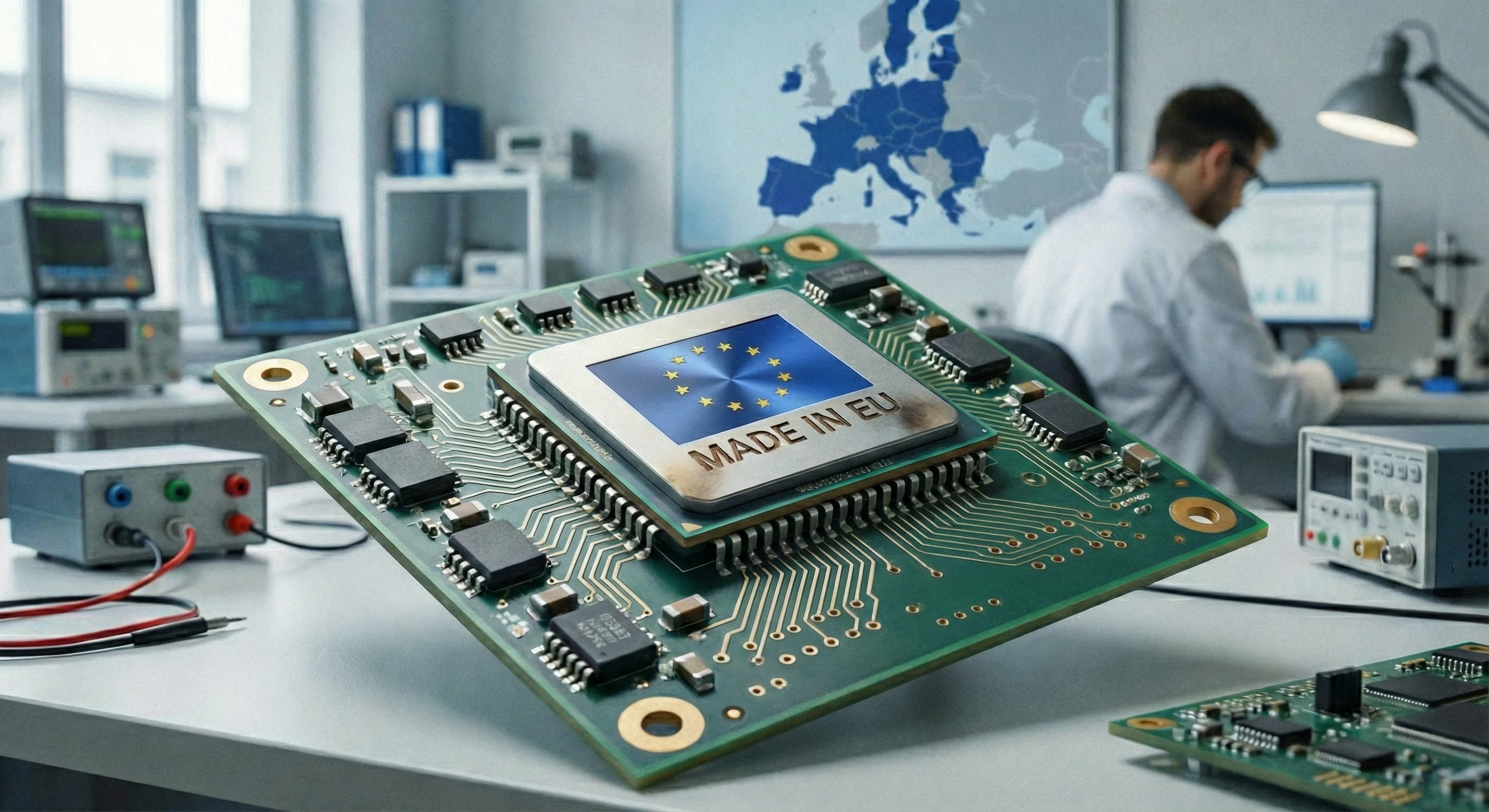
- Service Definition
- EU hardware development with full supply chain independence. GDPR, CRA, EU Chips Act & Ecodesign compliant — vetted EU partners.
EU Hardware Sovereignty
What is EU Hardware Sovereignty?
EU Hardware Sovereignty is the strategic capability to design, manufacture, and verify electronic systems entirely within the European Union. It ensures independence from non-EU supply chains, compliance with the EU Chips Act and GDPR, and protection against geopolitical risks, making it essential for critical infrastructure, defense, and secure IoT deployments.
EU hardware sovereignty means designing, manufacturing, testing, and maintaining the entire lifecycle of electronic hardware within the European Union — free from dependence on non-EU suppliers, fabrication facilities, or cloud infrastructure. This is critical for defense dual-use systems and critical infrastructure security.
Inovasense manages hardware projects with a focus on maximum supply chain independence, coordinating a network of vetted EU-based engineering and manufacturing partners. While a 100% EU-only BOM is the ultimate ideal, practical reality often requires global sourcing. We help clients find and master the best options on the path to this goal — prioritizing EU alternatives where available, and managing risk where global dependencies remain.
Why EU-Based Hardware Development Matters in 2026
The EU regulatory environment for electronics is the most comprehensive in the world. Between 2024 and 2027, five major regulations will fundamentally change how connected products are designed, manufactured, and sold in Europe. An EU-based development partner understands these regulations natively. We help you navigate the trade-offs between strict sovereignty and commercial viability, coordinating architectures that maximize compliance while acknowledging supply chain realities.
2026 Regulatory Landscape
| Regulation | Code | Effective | Requirement | Impact on Hardware |
|---|---|---|---|---|
| GDPR | EU 2016/679 | 2018 | Data protection by design (Art. 25) | Local processing, encryption, access control |
| Cyber Resilience Act | EU 2024/2847 | 2027 mandatory | Cybersecurity for all connected products | Secure boot, SBOM, 5-year vulnerability management |
| NIS2 Directive | EU 2022/2555 | Oct 2024 | Supply chain security | Secure development lifecycle, incident response |
| RED Delegated Act | 2022/30 | Aug 2025 | Cybersecurity for radio equipment | Authentication, secure boot, update mechanisms |
| EU AI Act | EU 2024/1689 | 2025–2027 | Risk-based AI governance | Conformity assessment for high-risk AI hardware |
| EU Chips Act | EU 2023/1781 | Active | Semiconductor sovereignty | EU chip design incentives, crisis monitoring |
| CBAM | EU 2023/956 | 2026 full | Carbon border adjustment | Carbon cost reporting for imported components |
| Ecodesign (ESPR) | EU 2024/1781 | 2025–2030 | Sustainable product design | Digital Product Passport, repairability, recycled content |
| Right to Repair | EU 2024/… | 2025 | Repair access and spare parts | Modular design, repair documentation, spare parts availability |
| REACH & RoHS | Ongoing | Ongoing | Material restrictions | Full material traceability, SCIP database reporting |
Your NIS2 and EU Chips Act readiness starts here.
NIS2 makes your customers responsible for their suppliers' security. With our 100% European supply chain, you guarantee zero risky components — passing procurement security audits instantly. No offshore dependencies, no FISA/CLOUD Act exposure.
Start with a Gap Analysis →Supply Chain Independence
Our tiered supply chain strategy includes:
- Sovereignty First — Prioritizing EU/EFTA components for critical subsystems (security, power, comms), including European FPGAs (NanoXplore, etc.).
- Strategic Multi-Sourcing — Where EU alternatives are unavailable, qualifying trusted global suppliers with diversification to prevent lock-in
- EU PCB fabrication — Board manufacturing at EU facilities with ISO 9001, IATF 16949, and UL certifications
- EU assembly — Pick-and-place, reflow, through-hole, and conformal coating at EU-based EMS partners
- Strategic inventory — Buffer stock management for long-lead-time components (>26 weeks)
- CBAM carbon reporting — Carbon intensity tracking for all imported components per EU 2023/956
- REACH/RoHS/SCIP — Full material declarations, substance reporting, and ECHA SCIP database submissions
- Conflict minerals — EU Conflict Minerals Regulation (2017/821) due diligence for tin, tungsten, tantalum, gold
Intellectual Property Protection
- EU legal jurisdiction — IP disputes resolved under EU law, not subject to foreign government access orders (FISA, CLOUD Act)
- NDA-first engagement — Every project starts with mutual NDA before any technical disclosure
- Source code and design files — Client owns 100% of all deliverables (RTL, firmware, PCB Gerbers, BOM)
- Vetted partner network — All partners operate under the same NDA and IP protection framework; no unauditable offshore dependencies
- Trade secret protection — EU Trade Secrets Directive (2016/943) enforced for all project documentation
End-to-End Service Model
We manage every stage of hardware product development through our EU partner network:
1. Product Design & Consultation
- Requirements engineering and feasibility analysis
- System architecture and technology selection
- Industrial design (enclosure, ergonomics, thermal)
- BOM costing, production cost optimization, and CBAM carbon impact analysis
- Digital Product Passport (DPP) preparation per ESPR requirements
2. Hardware Development
- Schematic capture and multi-layer PCB design (Altium Designer, KiCad)
- FPGA/SoC design (VHDL, SystemVerilog) — see FPGA Design Services
- Firmware development (C/C++, Rust, Zephyr RTOS)
- Mechanical design (SolidWorks, Fusion 360)
- Secure-by-design architecture for CRA compliance
3. Rapid Prototyping
- 3D printing (FDM, SLA, MJF) for enclosure iteration
- Small-batch PCB assembly for design validation
- Functional prototype delivery in 4–8 weeks
- Pre-compliance EMC screening to de-risk lab submissions
4. Testing & Certification
| Test Type | Standards | How We Help |
|---|---|---|
| EMC | EN 55032, EN 55035, EN 61000-4-x | Pre-compliance chamber + accredited lab partnership |
| Safety | EN 62368-1, EN 60950-1 | Dielectric, leakage, ground continuity testing |
| Environmental | IEC 60068, MIL-STD-810H | Climate and vibration chambers |
| Radio | EN 300 328 (2.4 GHz), EN 300 220 (sub-GHz) | RF shielded room, spectrum analyzer |
| Cybersecurity | CRA (2024/2847), RED DA (2022/30) | Vulnerability assessment, penetration testing, SBOM |
| Reliability | IEC 60068 HALT/HASS | Accelerated life testing for production screening |
5. Industrial Production
- Production line setup and process qualification (PPAP)
- Quality management (IPC-A-610, IPC J-STD-001, IPC Class 2/3)
- Functional test fixture design and automated end-of-line testing
- Serial number management, traceability, and Digital Product Passport data
- Logistics coordination and fulfillment
6. Post-Production Support
- Warranty management and field failure analysis
- Spare parts management (EU Right to Repair compliance)
- Secure OTA firmware update infrastructure (5-year CRA obligation)
- Component obsolescence monitoring and last-time-buy management
- End-of-life product management and WEEE compliance
EU Commitment
Inovasense operates within the framework of EU industrial policy, including alignment with:
- European Chips Act (EU 2023/1781) — Supporting the EU’s goal of 20% global semiconductor market share by 2030
- Horizon Europe — Participation in EU research and innovation programs
- European Green Deal — Sustainable manufacturing practices, circular electronics design, CBAM reporting
- EU Cyber Resilience Act — CRA-compliant development processes as standard
- ENISA guidelines — Following EU cybersecurity agency best practices
- EDIP / EDIRPA — Alignment with European Defence Industrial Programme for defense-adjacent projects
All work is coordinated through EU-based partners. No subcontracting to non-EU entities without explicit client approval.
Sources & Official References
- Cyber Resilience Act — Regulation (EU) 2024/2847 — EUR-Lex (Official Journal of the EU)
- NIS2 Directive — Directive (EU) 2022/2555 — EUR-Lex (Official Journal of the EU)
- RED Delegated Act — Regulation (EU) 2022/30 — EUR-Lex (Official Journal of the EU)
- EU AI Act — Regulation (EU) 2024/1689 — EUR-Lex (Official Journal of the EU)
- GDPR — Regulation (EU) 2016/679 — EUR-Lex (Official Journal of the EU)
- RoHS Directive — 2011/65/EU — EUR-Lex (Official Journal of the EU)
- REACH — Regulation (EC) No 1907/2006 — EUR-Lex (Official Journal of the EU)
- WEEE Directive — 2012/19/EU — EUR-Lex (Official Journal of the EU)
- EU Dual-Use Regulation — Regulation (EU) 2021/821 — EUR-Lex (Official Journal of the EU)
Guides in this area
Frequently Asked Questions
What is EU hardware sovereignty?
EU hardware sovereignty means designing, manufacturing, testing, and maintaining electronic hardware entirely within the European Union — free from dependence on non-EU suppliers, fabrication facilities, or cloud infrastructure. It ensures compliance with GDPR, the EU Chips Act, and protection against geopolitical supply chain risks.
Why should I develop hardware in the EU?
EU-based hardware development provides IP protection under EU law (not subject to FISA/CLOUD Act), native compliance with GDPR and the Cyber Resilience Act, CBAM carbon cost advantages, and supply chain resilience against geopolitical disruptions. By 2027, the CRA mandates cybersecurity requirements that EU-based partners understand natively.
What is the EU Chips Act?
The EU Chips Act (EU 2023/1781) is a €43 billion investment program to strengthen European semiconductor sovereignty, aiming for 20% global chip market share by 2030. It supports EU-based chip design, provides crisis monitoring mechanisms, and incentivizes domestic semiconductor manufacturing.