What is Edge AI in 2026?
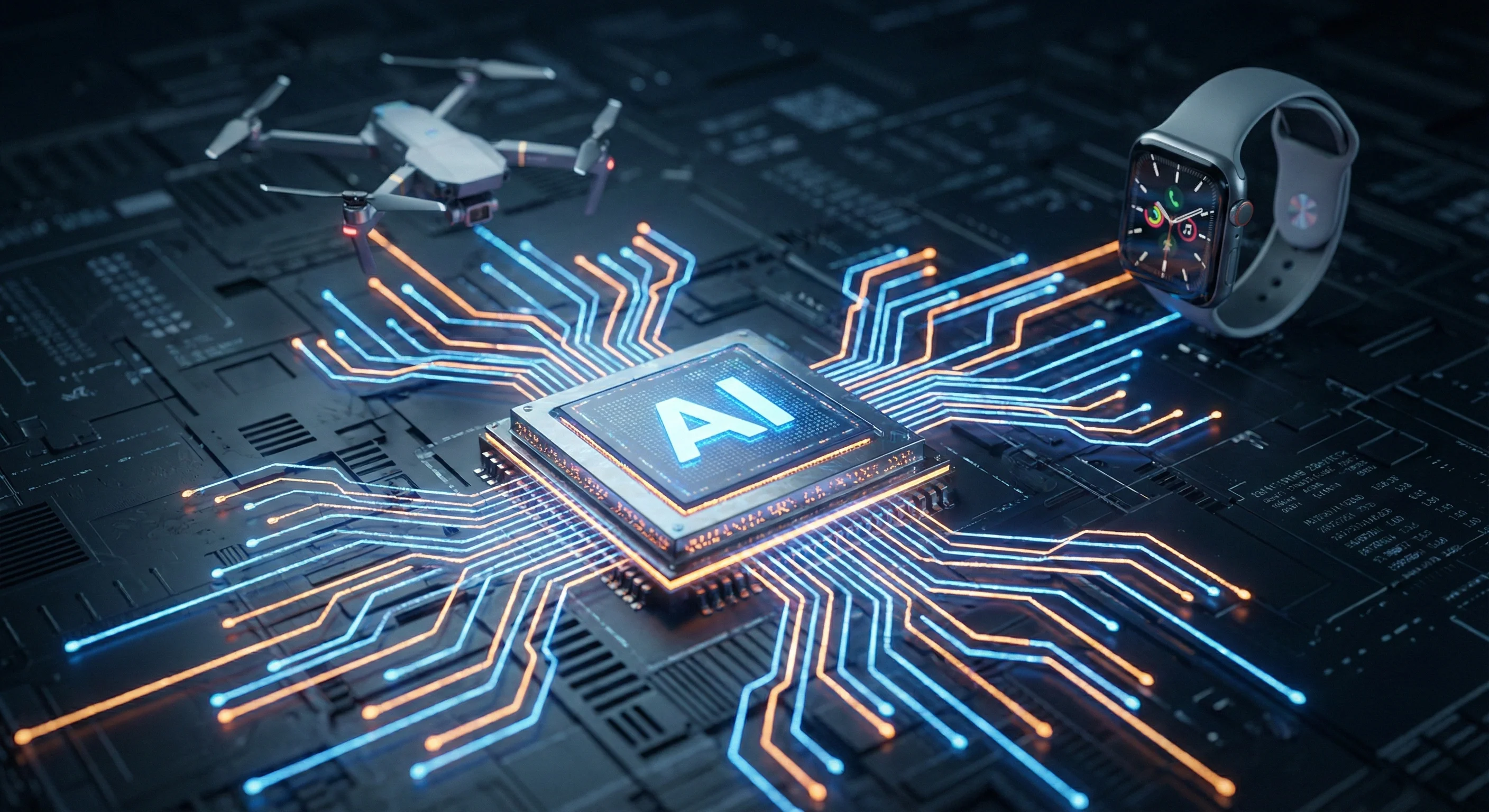
Edge AI involves running machine learning inference directly on embedded devices like microcontrollers and FPGAs, rather than in the cloud. This approach eliminates latency, ensures data privacy, and enables real-time decision-making for autonomous systems and industrial IoT.
Edge AI — running machine learning inference directly on embedded devices rather than in the cloud — is no longer experimental. With microcontrollers like the STM32N6 delivering 600 GOPS through dedicated neural processing units, and FPGA platforms like Lattice sensAI achieving always-on inference at under 1 mW, on-device intelligence has become practical for mass deployment.
This article examines where Edge AI delivers measurable value today, the hardware platforms that make it possible, and where the technology is heading.
Healthcare: Real-Time Patient Monitoring Without Cloud Dependency
In clinical settings, Edge AI enables continuous patient monitoring with immediate anomaly detection — no internet connection required. This matters in:
- ICU vital sign analysis — Wearable sensors running lightweight CNNs on Nordic nRF5340 (dual Cortex-M33) detect arrhythmias with <50 ms latency and 96%+ accuracy, alerting staff before traditional threshold alarms
- Remote patient monitoring — NB-IoT-connected devices with on-device inference process ECG, SpO2, and motion data locally, transmitting only anomalies to reduce bandwidth by >95%
- Surgical instrument tracking — UWB + IMU sensor fusion on real-time systems provides sub-centimeter positioning for instrument tracking during procedures
The privacy advantage is critical: under GDPR Article 25 (data protection by design), processing patient data on-device eliminates the need to transmit sensitive health information to cloud servers, simplifying compliance significantly.
Manufacturing: Predictive Maintenance and Visual Inspection
The manufacturing ROI for Edge AI is straightforward to calculate:
| Application | Hardware | Inference Time | Impact |
|---|---|---|---|
| Vibration anomaly detection | STM32H7 + MEMS accelerometer | 2 ms | 15–30% reduction in unplanned downtime |
| Visual defect inspection | NVIDIA Jetson Orin Nano | 8 ms per frame | 99.2% defect detection rate vs 85% manual |
| Acoustic leak detection | ESP32-S3 + MEMS microphone | 5 ms | Detects leaks before pressure drop is measurable |
| Motor current analysis | Infineon PSoC 62 | 1 ms | Bearing failure prediction 2–4 weeks in advance |
The key insight: Edge AI doesn’t replace cloud analytics — it handles the real-time, safety-critical layer. A vibration sensor that detects a bearing anomaly in 2 ms can trigger an immediate machine shutdown, while the same data, sent to the cloud for trend analysis, improves the predictive model over time.
Autonomous Systems: Where Latency Is Non-Negotiable
For autonomous vehicles, drones, and mobile robots, cloud-based AI is architecturally impossible — a 200 ms round-trip to a cloud server at highway speed means the vehicle has traveled 5.5 meters blind. Edge AI is the only viable approach:
- Object detection — YOLOv8-nano on Jetson Orin NX achieves 30 FPS at 640×640 with INT8 quantization, sufficient for real-time obstacle avoidance
- Sensor fusion — Extended Kalman Filters combining LiDAR, camera, and IMU data on Zynq UltraScale+ with <500 µs fusion latency
- Path planning — FPGA-accelerated A*/RRT* algorithms for deterministic path computation in dynamic environments
The Hardware Landscape in 2026
The Edge AI silicon ecosystem has matured significantly:
| Platform | AI Performance | Power | Sweet Spot |
|---|---|---|---|
| ARM Cortex-M55 + Ethos-U55 | 128–512 GOPS | 10–50 mW | Keyword spotting, gesture recognition |
| STM32N6 (Neural-Art NPU) | 600 GOPS | 50–100 mW | Image classification, anomaly detection |
| Lattice sensAI (iCE40/CLNX) | Custom datapath | <1 mW | Always-on presence/motion detection |
| NVIDIA Jetson Orin Nano | 40 TOPS | 7–15 W | Multi-camera vision, complex models |
| NXP i.MX 8M Plus | 2.3 TOPS | 2–3 W | Industrial vision, voice processing |
The trend is clear: AI inference is moving from dedicated GPU servers to system-on-chip solutions that integrate NPUs alongside traditional CPU cores. This means AI capability is becoming a standard feature of embedded hardware, not a specialist add-on.
What’s Next: On-Device Training and Federated Learning
The frontier is shifting from on-device inference to on-device learning. Techniques like federated learning allow models to improve locally without sharing raw data, and quantization-aware training (QAT) produces models that are optimized for INT8 hardware from the start, closing the accuracy gap between cloud and edge models to <2% for most classification tasks.
At Inovasense, we design custom Edge AI hardware — from sensor selection and PCB design through model optimization, deployment, and OTA update infrastructure. Our platforms support TensorFlow Lite for Microcontrollers, ONNX Runtime, and Edge Impulse, deployed on ARM Cortex-M, RISC-V, and FPGA targets. Contact us to discuss your Edge AI project.